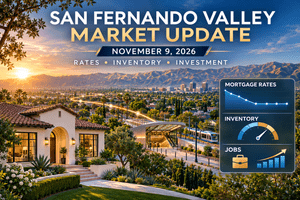
The San Fernando Valley housing market is sending buyers and sellers an interesting message: fewer properties are available than three months ago, but the homes that are listed are taking longer to sell.
At the same time, mortgage rates have declined for three consecutive weeks, major Metro projects are moving forward, and new county financing could attract additional businesses and jobs.
Here is what happened—and what it could mean for buyers, sellers and homeowners across Sherman Oaks, Chatsworth, Granada Hills, Porter Ranch, West Hills and other San Fernando Valley communities.
The Quick Take
The average 30-year fixed mortgage rate declined to 7.18%.
Active San Fernando Valley inventory fell approximately 6.9% between June and September.
Months of available housing supply increased from 3.8 to 4.8 months because sales slowed.
Construction is advancing on the East San Fernando Valley Light Rail project.
The proposed Sepulveda Transit Corridor is entering another important public-review period.
A new county loan fund is intended to support business expansion and job creation.
Inflation and import costs remain important financial risks for California households.
Mortgage Rates Declined—but Financing Remains Expensive
The average 30-year fixed mortgage rate reached 7.18% on November 5, down from 7.24% the previous week and 7.32% two weeks earlier. The average 15-year fixed rate was 6.57%, according to Freddie Mac.
Three consecutive weekly declines are encouraging, but buyers should keep the change in perspective. A slightly lower rate can reduce a monthly payment, but California home prices mean that even a small difference in credit score, down payment, loan fees or insurance costs can materially change affordability.
The Federal Reserve maintained its target interest-rate range at 3.75% to 4.00% on October 28. Although the federal funds rate is not a mortgage rate, it influences borrowing conditions throughout the economy. Read the Federal Reserve statement.
Inflation remains one of the biggest obstacles to substantially lower rates. September consumer inflation was 3.7% annually, while the Federal Reserve’s preferred PCE measure was 3.6%. The October inflation report is scheduled for November 10. A higher-than-expected reading could place upward pressure on market rates, while moderating inflation could help borrowing conditions. Neither outcome is guaranteed.
What buyers should do
Instead of trying to predict the perfect rate, buyers can compare multiple lenders, request a detailed Loan Estimate and calculate payments at several interest-rate levels. A buyer should also include property taxes, homeowners insurance, HOA dues and maintenance—not only principal and interest.
Fewer Listings, but More Time for Buyers
The latest complete San Fernando Valley data from the Southland Regional Association of REALTORS® presents an important distinction between the number of listings and the amount of available supply.
Active homes and condominiums: 2,815 in June versus 2,621 in September, a 6.9% decline.
Active single-family homes: 1,904 in June versus 1,780 in September, a 6.5% decline.
Active condominiums: 911 in June versus 841 in September, a 7.7% decline.
Months of inventory: 3.8 months in June versus 4.8 months in September.
New listings: 1,240 in June versus 1,002 in September, a 19.2% decline.
Average days on market: 37 days in June versus 40 days in September.
Sources: SRAR June report and SRAR September report.
There were approximately 194 fewer active properties in September than in June. Nevertheless, months of supply increased by approximately 26% because sales slowed more rapidly than inventory declined.
This does not automatically make the Valley a buyer’s market. It does mean buyers may have more time to inspect a property, review disclosures and negotiate repairs, credits or pricing—especially when a home has been listed for an extended period.
Sellers should pay close attention to recent comparable sales, property condition and current competition. A well-presented home priced for today’s market can still attract strong interest. An overpriced property may accumulate market time and eventually require a reduction.
Major Transportation Investment Is Moving Forward
Metro has started construction on the East San Fernando Valley Light Rail Transit Project, a 6.7-mile line with 11 planned stations along Van Nuys Boulevard.
The project has an estimated construction cost of approximately $3.998 billion. Metro projects that construction and operations could generate more than 18,000 direct and indirect jobs. Utility work is already creating nighttime lane reductions and detours in portions of Van Nuys Boulevard. Read the LA Metro announcement.
Transportation investment can improve access to employment, schools, health services and local businesses. However, residents and prospective buyers should also evaluate construction schedules, noise, traffic changes and access around a specific property.
Infrastructure investment does not guarantee that nearby property values will increase.
A Proposed Underground Connection to the Westside
The Sepulveda Transit Corridor could eventually create a high-capacity underground rail connection between the San Fernando Valley and Westside.
Metro’s locally preferred alternative would connect Van Nuys Metrolink with the Metro E Line near Expo/Sepulveda, with proposed stations near Ventura Boulevard, UCLA and Wilshire/Westwood. Metro estimates that the complete trip could take approximately 20 minutes and attract more than 100,000 daily riders.
The project is still undergoing environmental review and has not received final approval. Public comments concerning station locations, facilities, traffic and environmental effects are due November 18, 2026. View the Sepulveda Transit Corridor project.
For real estate consumers, the appropriate approach is to monitor the project without assuming a particular station, completion date or effect on property values until the planning and approval process advances.
New Financing Could Support Business Growth and Jobs
Los Angeles County announced a $12 million Graduation and Manufacturing Space Fund intended to support facilities for life-science and manufacturing businesses.
Eligible property owners and qualified long-term leaseholders may be able to request loans of up to $5 million for construction, infrastructure, code-compliance work and tenant improvements. County officials estimate that the program could support 60,000 to 80,000 square feet of new space and create or retain approximately 200 jobs within two years.
The first application phase is expected to open in mid-November. The program is countywide, so it should not be presented as confirmation that a particular project or business is coming to the San Fernando Valley. Read the LA County announcement.
A stronger regional employment base can support housing demand over time, but the ultimate effect will depend on which projects receive financing and where the resulting jobs are located.
National Financial Changes Affecting California
The national economy added 165,000 jobs in October, while unemployment remained relatively stable at 4.1%. Average hourly earnings increased 3.1% over the previous year. A resilient labor market can support consumer confidence, but it may also allow the Federal Reserve to remain patient before reducing rates. See the Bureau of Labor Statistics report.
California homeowners may also benefit from the increased federal deduction limit for state and local taxes. For 2026, the combined SALT deduction limit is $40,400, subject to income-based reductions beginning above $505,000 of modified adjusted gross income. It is an itemized deduction—not a direct tax credit—and individual benefits will vary. Review the IRS information.
Import prices, meanwhile, were 8.1% higher annually in September. Rising import costs can affect appliances, vehicles, construction materials and small-business expenses. The Port of Los Angeles also processed a record 1.04 million containers during September, demonstrating the continued importance of international trade to Southern California employment and economic activity.
What This Means for the San Fernando Valley
The market is not moving in only one direction.
Buyers have somewhat more negotiating room because properties are taking longer to sell, but elevated mortgage rates continue to limit purchasing power. Sellers face less new competition than during the summer, but accurate pricing and strong presentation are increasingly important. Homeowners and investors should monitor transportation planning, business investment, inflation and borrowing costs without treating any single announcement as a guarantee of appreciation.
If you are considering buying or selling in Sherman Oaks, Altadena, Chatsworth, Granada Hills, Porter Ranch, Simi Valley or West Hills, EH WORLDWIDE REALTY can help you interpret current local conditions, compare communities and develop a strategy based on your goals.
Explore our Communities, request a personalized Home Valuation or Contact EH WORLDWIDE REALTY to discuss your next move.
This article is for general educational purposes and does not provide legal, tax, insurance or financial advice. Program availability, interest rates and project schedules may change.